What Inspired the Laussel Moon?
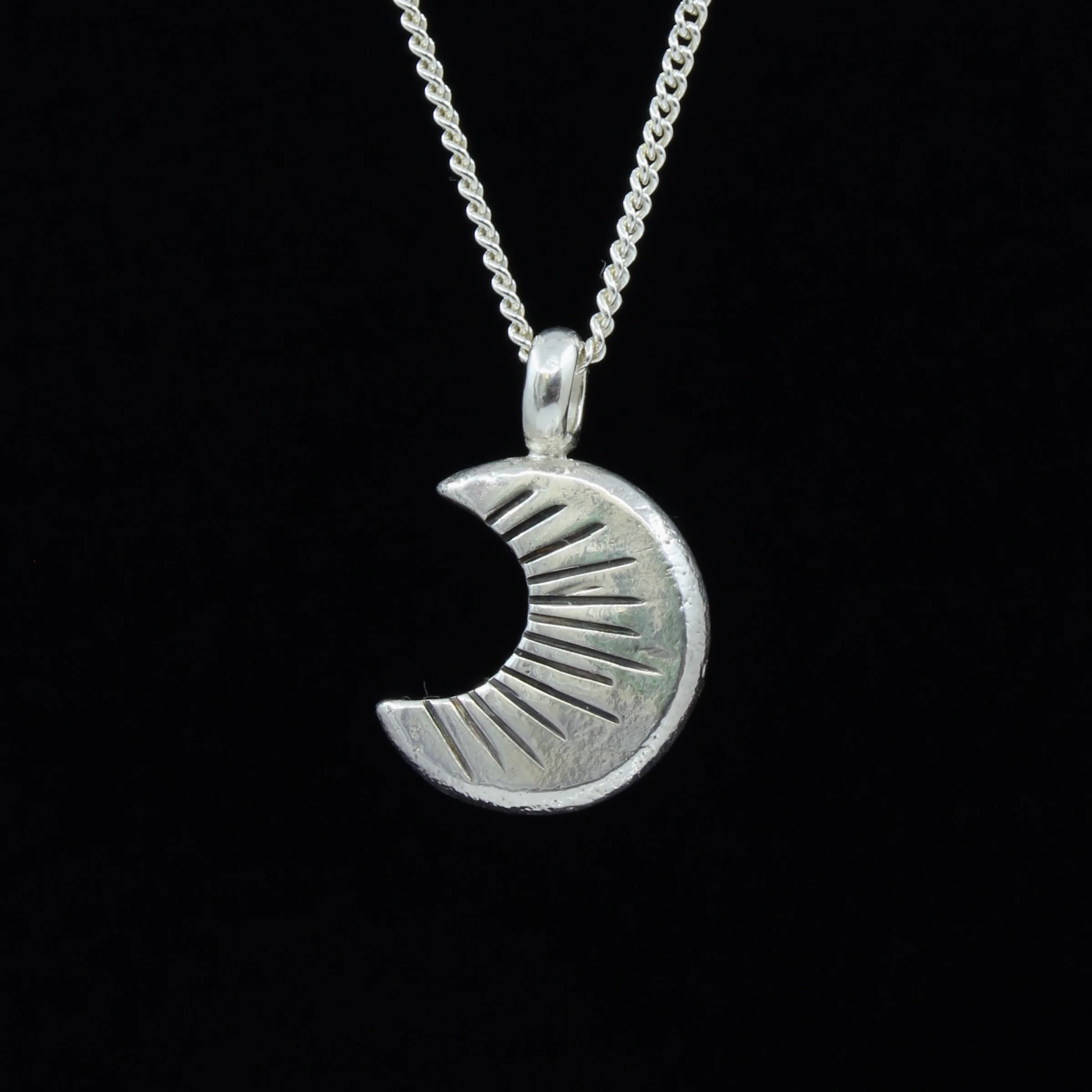
As Ornate Alchemy launches in 2026, I wanted to share with you the inspiration behind my newest silver pendant. The Laussel Moon draws from ancient artistry, whilst echoing timeless feminine wisdom.
Pictured: Laussel Moon - each pendant is hand-forged and completely unique, yet every crescent bears exactly thirteen lines.
Back in my Imi and the Deer days I found inspiration in one of my favourite plants. It was early summer and the chamomile flowers were starting to bloom in the planter next to the studio. Chamomile is the ultimate magic plant. Not only is it anti-inflammatory but it can ease anxiety, help us sleep and act as a natural anti-histamine - it can even make sick plants better! As I picked and dried the flowers to make tea, I reflected on the healing knowledge we’d had at some point in the past, knowledge that we needed to reclaim. I wanted to make a piece of jewellery to convey my thoughts and the design was lying in the palm of my hand.
The Ancient Goddess pendant was born.
In the early days it became my best selling design. I loved how the women wearing my pendant saw her as a sun and although I had never expressly made the connection, I came to realise that’s exactly what she is. I might have been inspired by the plant but chamomiles have a long association with the sun. After all the ancient Egyptians called it the ‘herb of the sun’ and dedicated the plant to Ra, their sun god.
And if there’s a sun, then there needed to be a moon.
Being a moon child, I’d already made several pendants displaying the moon in all her glorious phases. Textured moons; accurate replicas with little craters; plain, shiny ones: but nothing felt right. What made the Ancient Goddess special was the hidden symbolism. I loved how it had a personal meaning for me and yet it had come to represent something new to the many customers wearing her.
Like the chamomiles, inspiration struck when I least expected it. This time it was a black and white image in a book I was reading. The author mentioned the Venus of Laussel and, familiar with other Venus figurines, I expected something similar.
I turned the page and there she was. The Venus of Laussel. My new muse.
You might have heard of Venus figurines, small female shaped statues that have been found scattered across archeological sites of Eurasia. Around 200 have been discovered to date, all from the Upper Palaeolithic period which makes the figurines between 10,000 and 40,000 years old. Often small enough to fit in the hand the Venus figurines (as they are colloquially referred to) were made from a range of natural materials and depicted a naked woman, sometimes with a voluptuous body displaying exaggerated female features such as breasts and hips. The purpose of these figurines is still a mystery: suggestions range from fertility statues or offerings, a religious icon of a ‘Mother Goddess’ figure, even self-depictions by female sculptors. Rather than sexual overtones, any woman looking downward at her own body would be able to understand how the angle of view could impact the proportions demonstrated in the figurines.
In principle, the Venus of Laussel bears the same similarities - enlarged breasts, hips and stomach with legs tapering to a point - but there were a couple of key differences which caught my attention. Firstly she is two-dimensional, a bas-relief carved into the limestone of a rock shelter (named Abri de Laussel) in Marquay, France. She is heavily contoured, showing a wonderful play of shadows and light, and painted with red ochre. Secondly, compared to the three dimensional figurines, her face is turned to the side in the carving. There has been some excitement and speculation in certain circles as this pose is suggestive of how early goddesses were portrayed. The Laussel Venus has her head turned away, almost demurely, and appears to be looking at something.
Which brings us to the key difference and the one that immediately sparked my interest. Venus was indeed looking at something: the object she was holding aloft in her right hand - an upturned crescent moon!
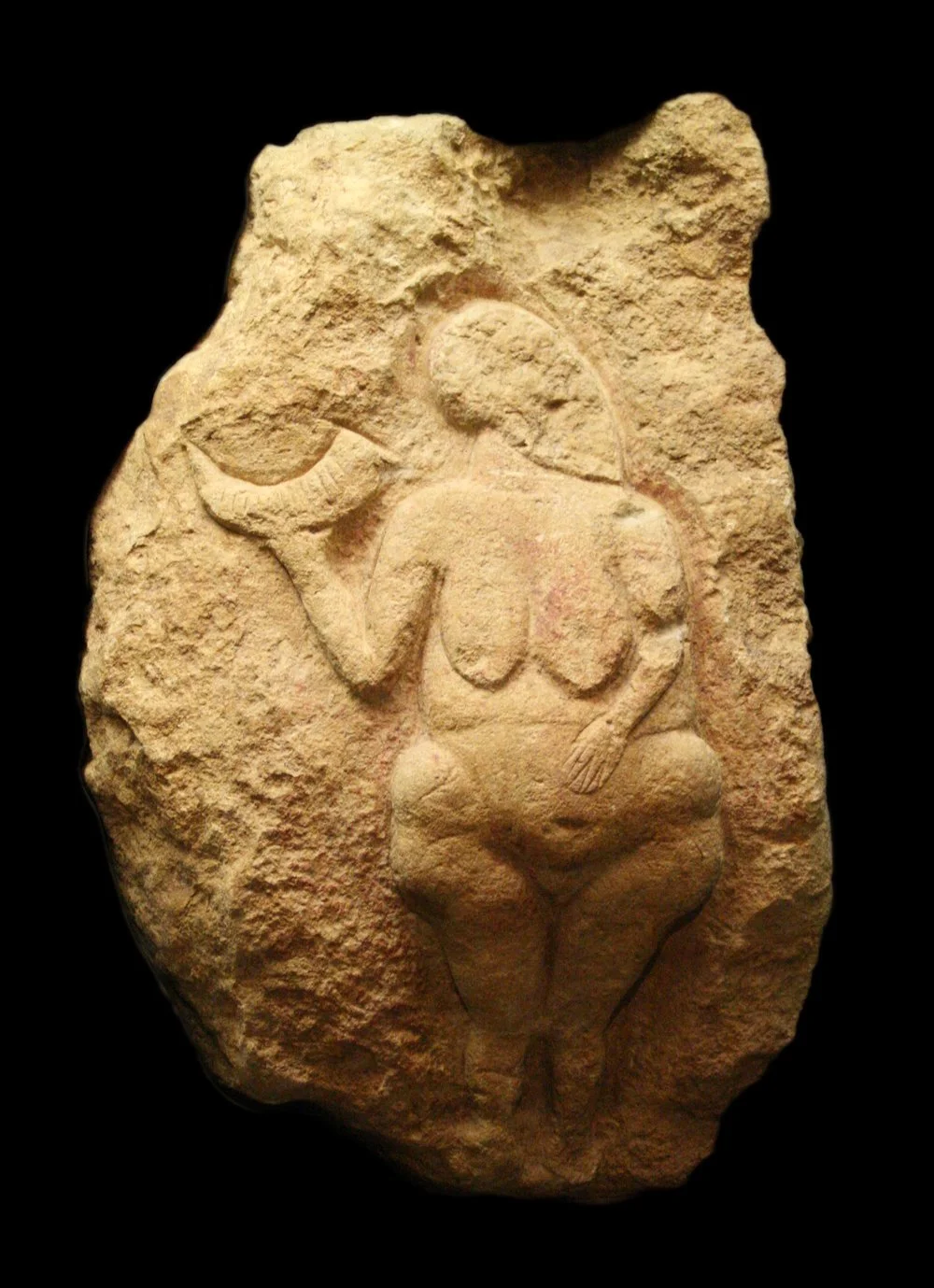
Venus of Laussel
Limestone bas-relief with red ochre
Approx 25,000 years old
Now, before we get too far into the realms of conjecture, I am aware it is in all likelihood not a crescent moon. The shape might be somewhat reminiscent of one, however the end closest to Venus is squared off making it more likely the horn of a cattle-like beast. It might even be a primitive cornucopia which would make sense if Venus figurines were indeed related to fertility as has long been suggested.
Looking at the carving the shape reminds me of holding a sea shell up to your ear to hear the waves. In fact this has been identified by some scholars as a possible explanation: Venus may be holding a rudimentary musical instrument. This has been suggested by examining the final distinguishing feature - the upturned crescent moon shape has lines notched into it, making it somewhat similar in style to a rasp.
However the number of lines notched into this crescent moon shape is thirteen.
Thirteen! Well isn’t that an interesting number and perhaps not one you’d expect to find. Remember, this isn’t a young kid drawing a picture, arbitrarily doodling a random number of lines. Whoever sculpted the Venus 25,000 years ago had to carve those lines into the rock with primitive tools; they could have used a lesser amount and still conveyed their meaning. But instead, they carefully, deliberately carved thirteen notches. The sculptor meant for there to be thirteen lines.
Naturally there has been a lot of speculation and debate amongst many experts and scholars as to the significance of the number thirteen in this carving. And this can’t be addressed without touching on the sticky subject of gender. You see if you look at it, the notches could represent an early method of counting or tally-marking - examples of bones with notching have been discovered from the Upper Palaeolithic era, one of the earliest being around 42,000 years ago. So counting markers did exist. But what makes this potential tally-marker controversial is that the depiction is being held aloft by a woman. It would be preferable therefore to suggest it is a musical instrument rather than something as advanced as a “counting device”, quite literally in the hands of women.
Of course we then need to ask if it were a counting tool, why were there thirteen notches? What could the significance of 13 be?
Just look to woman here for an answer. On average women have thirteen menstrual cycles in a year. This Venus carving was found in a rock shelter, painted with red ochre: there is every possibility this could have been a place for women to go during menses. She might even represent fertility: after all, the average time from menstruation to ovulation is 12-14 days. Perhaps women were using the number thirteen as a rudimentary counter for when they would be fertile?
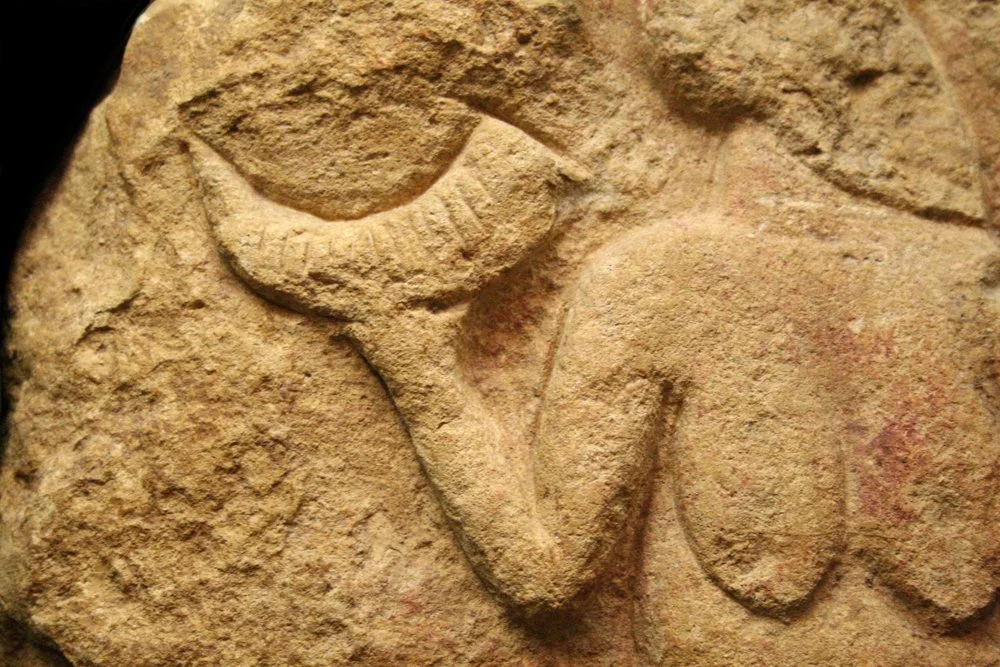
A close-up of the horn, bearing thirteen notches, belonging to the Venus of Laussel.
Let’s take this significance one step further. Something else occurs thirteen times a year. Something that shares a connection with both women and cycles.
That’s right, the moon.
It is possible to have thirteen moons in a year - in fact this year will see thirteen full moons. A lunar cycle is often deemed to be 28 days, hence the connection with women’s cycles. This number is an approximation calculated from the 27.3 days the moon takes to orbit Earth and the 29.5 days it takes to complete a full phase cycle, also known as a lunation. Where a lunar cycle of 28 days falls neatly into our year, the lunation from phase to phase doesn’t. This means that every couple of years the extra days catch up and we have what is known as a “blue moon” where we get an extra full moon in one month. This May will see two full moons.
Of course, all this is relevant because in modern times we follow a solar calendar of twelve months, which splits nicely into four seasons of three months. However ancient civilisations, such as the Inca and Maya, followed a lunar calendar of thirteen months. Many indigenous peoples who live connected to the Earth actually followed a lunar calendar, even into more recent times. The Cherokee for example followed a traditional year split into thirteen months of 28 days, roughly tracking the time it takes for the moon to cycle the earth.
Suddenly the horn with the crescent moon shape takes on a whole new significance.
I was so taken with all these concepts that I had to make a piece honouring the mysterious Venus of Laussel and her myriad meanings. Finally I had my moon design: a solid comforting weight of silver - moon metal - shining with a gentle light and marked with exactly thirteen notches. I tried to replicate the feel of ancient craftwork in making the piece: melting the metal, forging it by hammer and anvil, shaping it by hand. I struck each of the thirteen notches individually, with intent, thinking of that venerable and forever unknown Venus sculptor every time the steel met the silver.
I want this piece to be a powerful reminder to women everywhere of our identity as daughters of the moon and daughters of the earth. Strong females, secure in our own bodies. Let it serve as a reminder of who we are and what ancient knowledge we once held aloft.
So as a tribute to that ancient Venus of Laussel I proudly wear my moon pendant every day and enjoy sharing her story with all who care to listen.