Guide to Hallmarking

If you’ve ever seen a series of marks on a piece of jewellery from the UK then chances are it’s a hallmark. Hallmarking is an important part of being a precious metal jeweller in the UK.
I’ve put together a quick guide to give an overview of what hallmarking is and to answer some of the most commonly asked questions.
What is hallmarking?
Hallmarking is a set of marks applied to precious metals by laser or punch. It is a mark to attest to the quality of the precious metals used. The independent Assay Office test the fineness of precious metals (such as silver and gold) and apply a mark to those that meet the requirements. It is a legal requirement in the UK to have precious metals of a certain weight hallmarked.
Why do we hallmark?
At its most basic, hallmarking is consumer protection. Precious metals are often alloys (a mix of different metals) and it needs sophisticated testing to identify the exact composition. Take silver for example. There are several well known silver alloys - do you think you’d be able to identify them by sight alone?
Fine silver is 99.9% pure silver (999) but it in its natural state is too soft to be used exclusively in jewellery. Instead it is combined with other metals, mostly copper, to create a 92.5% silver alloy - what we know and love as sterling silver (925).
The Assay Office checks the exact composition then marks the metal to guarantee it is genuine.
What are the exemptions?
Hallmarking goes by weight. Legally any item of silver weighing 7.78 grams or more requires a hallmark. The limit is 1.0 grams for gold and 0.5 grams for platinum. Anything lower than these specified weights does not legally require hallmarking to be sold in the UK.
When did hallmarking begin?
Hallmarking actually has quite a long history. It can be initially traced back to 1238 when King Henry III attempted to regulate the composition of silver and gold as a method of preventing fraud. In 1300 King Edward I introduced the leopard’s head mark to be stamped on goods that had been assayed - to this day London Assay Office still uses the leopard head as their symbol.
Where does hallmarking take place?
At one point in time there were 10 Assay Offices in the UK, but now only 4 remain: Birmingham, Edinburgh, Sheffield and London. Each has its own distinguishing mark: anchor, castle, rose and leopard respectively. I am registered with Edinburgh Assay Office so my hallmark includes the castle symbol.
What does a hallmark look like?
A hallmark is comprised of a series of symbols, each with their own meaning. They form an identification so you can tell who made the piece and when it was assayed, as well as the precious metal used.
The first mark is an individual maker’s mark, usually the maker’s initials, in a unique shape. Next is the metal purity e.g. 925 for sterling silver (the rampant lion is for Scottish silver; the lion passant is used for English silver). There is a symbol to identify the Assay Office branch and finally a stylised letter which indicates the year of assay.
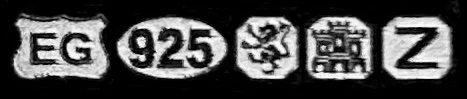
This is an example of my personal hallmark.
Hallmarks can be applied by either laser or punch so they can vary in size and depth. Some artists like their hallmarks to be a feature of their work, but the metal needs to be very heavy otherwise it can distort when struck with a punch.
What pieces are hallmarked at Ornate Alchemy?
When working with sterling silver, I only submit the pieces that are legally required to be hallmarked (items that weigh over 7.78 grams of silver.) The exception would be mixed metal pieces - I choose to hallmark my Ancient Goddess designs so you can be assured you are receiving a genuine piece of solid gold, rather than a coating like gold plating or vermeil.
Only precious metals are hallmarked. Stainless steel is a base metal, so any jewellery made by Phil don’t require hallmarking.
Where can I find more information?
All jewellers are required to display a dealer’s notice - these notices can be accessed directly from the ‘hallmarking’ section on the homepage. Additionally more information regarding hallmarking can be found at www.edinburghassayoffice.co.uk
Hope you found this guide helpful! Let me know if you’d like more information on hallmarking or any ideas for other topics you’d like covered on the blog.